/Hubspot_FG%20Logo%20Name%20Purple%20Bkgd.svg)
Risk Tolerance Tracker
Americans are growing more risk averse after the events of the past year
Key findings from F&G's 2026 Risk Tolerance Tracker
After a turbulent year marked by rising costs, healthcare concerns and economic uncertainty, Americans are growing more averse to financial risk and rethinking how they prepare for retirement.
F&G’s sixth annual Risk Tolerance Tracker reveals how the events of the past 12 months have reshaped Americans’ views on risk, financial security and retirement readiness.

- 77% of Americans say recent events have made them more financially cautious, up from last year
- Two thirds (66%) worry about their retirement income, given current economic conditions
- Healthcare and long-term care costs surged to become the second highest financial concern
- Americans in their 40s report high levels of financial stress
- Investors are reacting proactively by revisiting their budgets, increasing savings and recalibrating their level of risk
Together, these findings point to a growing sense of vulnerability and the need for trusted advisors to help investors move forward with confidence.
Americans are pulling back on risk
More than three quarters of Americans (77%) say the past year has made them more cautious financially, which is a four-point increase from last year. Persistent affordability pressures, combined with uncertainty around long-term security, are weighing heavily on household confidence and reshaping retirement planning decisions.
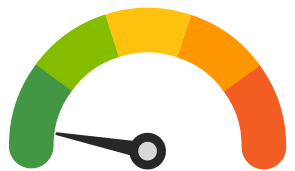
77% are less likely to take financial risks, compared to
73% of last year's respondents
Financial pressure peaks in Americans' 40s
While financial anxiety spans generations, it is most acute among Americans in their 40s, a decade often defined by peak earnings, family responsibilities, housing costs and retirement planning.
Key findings include:
of Americans in their 40s are becoming more risk averse
say their financial safety net has eroded over the past year
This generational experience highlights growing pressure on those approaching retirement without the cushion they expected.
Healthcare costs emerge as a major financial threat
Looking ahead to 2026, Americans’ financial worries are evolving:
- Inflation remains the top concern (48%), though it declined slightly year over year
- Healthcare and long-term care costs jumped from sixth to second highest concern, rising 8 points to 31%
Other notable concerns include:
- Rising taxes (25%)
- Energy and gas prices (24%)
- Recession fears (23%)

Americans are adapting their financial plans to better manage risk
Investors are proactively taking action to ensure their savings and retirement plans remain strong.
/Purple/person-money-reach_purple.png?width=600&height=600&name=person-money-reach_purple.png "Person reaching in multiple directions for money")
Common actions include:
- Increasing their monthly savings
- Updating retirement plans
- Supplementing their main income source
- Creating or revisiting budgets
- Changing to more cautious, less risky investments
54%Despite their worries, more than half of respondents (54%) are not working with a financial professional who can help them navigate their financial options.
Investors seek ways to recession-proof their savings
Many investors have made changes recently to be more cautious or adjust their investments to be more recession resistant, with a sharp difference among the generations:
Guaranteed income financial products, like annuities, can help investors diversify their retirement savings during times of economic volatility. Few respondents owned an annuity, but almost half were willing to explore new financial products:
48%are likely to explore new financial products
only 13% own an annuity
Why these findings matter
The 2026 Risk Tolerance Tracker highlights a clear shift:
/Dark%20Mode_Yellow/money-bag-arrows-left-right_dm_yellow.png?width=150&height=150&name=money-bag-arrows-left-right_dm_yellow.png) Americans feel more exposed financially
Americans feel more exposed financially
/Dark%20Mode_Yellow/arrow-down-circle-money_dm_yellow.png?width=150&height=150&name=arrow-down-circle-money_dm_yellow.png) Appetites for financial risk are shrinking
Appetites for financial risk are shrinking
/Dark%20Mode_Yellow/hand-open-money_dm_yellow.png?width=150&height=150&name=hand-open-money_dm_yellow.png) Investors are open to changes that reduce financial risk
Investors are open to changes that reduce financial risk
The data underscores the growing need for thoughtful retirement strategies, education and guidance as households navigate affordability pressures and economic uncertainty.

Whether investors are in the earlier stages of planning or navigating the critical years leading up to retirement, a trusted advisor can help investors cut through the noise, assess risk realistically and guide an ongoing retirement strategy that balances protection, growth and guaranteed income, so they can move forward with greater confidence amid volatile times.”
Ron Barrett - Chief Distribution Officer, F&G
Talking with a financial and insurance professional can help you turn your retirement aspirations into reality.
About the research
The research was conducted by Censuswide among a sample of 1,601 US respondents (aged 30+) who have at least $10,000 in financial products/investable assets. Respondents are either a financial decision-maker for the household or share responsibility for financial decisions. The data was collected between November 14 and November 26, 2025.
“F&G” is the marketing name for Fidelity & Guaranty Life Insurance Company issuing insurance in the United States outside of New York. Life insurance and annuities issued by Fidelity & Guaranty Life Insurance Company, Des Moines, IA.
(01-2026) 25-1280